
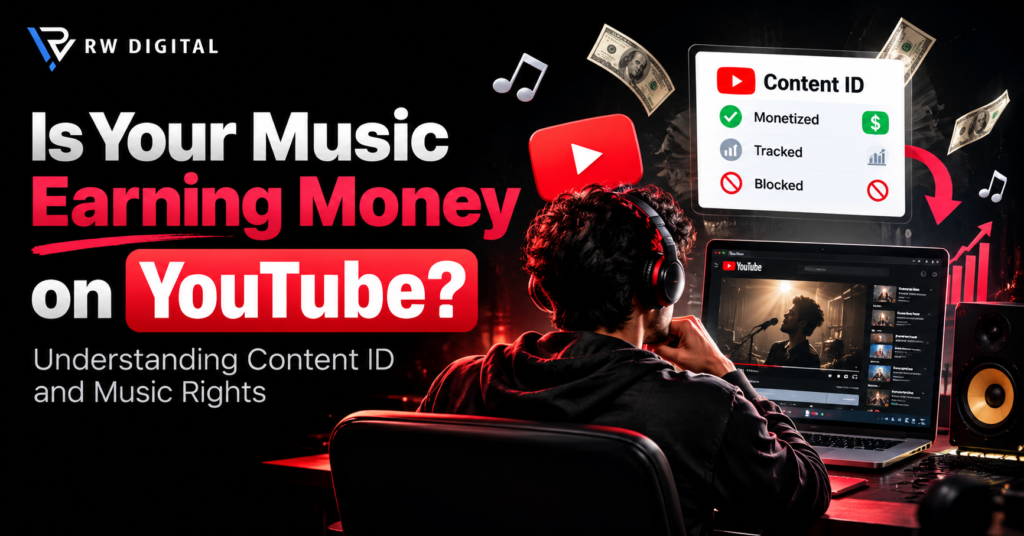
Have you heard your songs on the radio? Your music may also be used in videos, Shorts, vlogs, dance performances and more. But when others use your music on YouTube, what happens to it? Does the money go to the video makers, or can the music owner earn too? And how can artists have a say in whether their music appears on YouTube?
Enter Content ID.
Music rights are a significant part of the financial side of music, and they can make or break an independent musician, singer, rapper, producer, composer or record label. Uploading a song is only the start. What matters just as much is how you treat its rights, how you approach monetisation decisions and how efficiently your music is distributed.
In this post we explain how YouTube Content ID works, how music rights affect monetisation, what artists need to know before registering their music, and how RW Digital can help with music monetisation and rights management.
What Is YouTube Content ID?
YouTube Content ID is a tool that helps eligible copyright owners identify and manage their material on YouTube.
Uploaded videos are checked against reference files provided by verified copyright owners. If a match is found, YouTube can place a Content ID claim on the video based on the rights owner’s settings.
Depending on the applicable rights and policies, the copyright owner may choose to:
- Monetise the matching video
- Track the video’s viewership statistics
- Block the video in particular scenarios or regions
These choices are subject to the rights owner’s policies and applicable rights. A Content ID claim does not necessarily mean the video is monetised.
YouTube also controls access to Content ID. Rights holders must verify that they own the rights they are registering and that those rights are exclusive. Having a YouTube account or releasing an original song does not give you automatic access to the system.
Official explanation: YouTube’s Content ID guide
How Content ID Works for Music Creators
Say an independent musician releases a new single called Midnight Drive.
One creator uses the song as the soundtrack to a travel video. Another uses it in a vlog. A third uses it in a film montage.
If the music is correctly registered as reference material through an approved Content ID partner, YouTube may be able to recognise matching audio in these uploads. What happens next depends on the rights and the monetisation policy in force. If monetisation is permitted and possible, the rights holder can earn revenue. Otherwise, they can track or restrict the matches.
Here is the process in brief:
- Rights check: The rights holder confirms the song is eligible and that they control the rights.
- Content registration: An approved partner submits suitable reference material to the Content ID system.
- Automatic matching: YouTube automatically scans uploaded videos for matches.
- Content ID claim: A matching video can receive a Content ID claim.
- Rights management: The policy in force decides whether the video is monetised, tracked or restricted.
- Revenue reporting: If revenue is earned, reporting and payment are handled by the rights holder or partner, as per the applicable agreement.
Remember that Content ID is a tool to help you track and manage the use of your music. It does not guarantee streams, views or revenue.
Can Others Use Your Music on YouTube While You Earn From It?
Yes, rights owners can earn from certain uses of their music through Content ID. But it depends on the following factors.
1. Music Ownership
You must hold the rights to the material you are registering. Owning the sound recording does not mean you own the underlying composition or any samples used in it.
For example, a performer may own the master recording, while the composition rights may belong to several writers or publishers. Understand these rights before you register a song.
2. Content ID Eligibility
Not every recording qualifies. YouTube asks for proof of exclusive rights and suitable reference material. Some remixes, compilations, non-exclusive samples and other material you do not exclusively control may not be eligible for Content ID registration.
3. Music Usage
Revenue varies depending on whether the matched video is eligible for monetisation, the claim policy, advertising activity, the viewer’s location and other platform factors. A song appearing in a video does not guarantee any particular amount of income.
4. Distribution and Rights Management
Your music may be registered, claimed, reported and paid for through the company or partner that administers it. Read the agreement carefully to understand fees, revenue splits, exclusions and payment terms.
YouTube Content ID vs Channel Monetisation
These two concepts are often confused, but they serve different purposes.
| Feature | YouTube Content ID | YouTube Channel Monetisation |
| Primary purpose | Identify and manage the use of eligible copyrighted material | Earn from qualifying content on a creator’s channel |
| Who can use it | Owners of qualifying music or other rights, under applicable arrangements | Owners of eligible channels |
| How it works | Scans uploads against reference material | Uses YouTube’s creator monetisation features |
| Access | Only qualifying rights owners and authorised partners | As per the YouTube Partner Program criteria |
| Guaranteed income? | No | No |
For example, an artist may upload official music videos to their own YouTube channel. The revenue from that channel depends on the channel’s eligibility and performance.
The same artist may also have eligible music used in videos uploaded by other people. Content ID can help manage that usage under the proper rights arrangements.
They are related opportunities, but they are not the same system.
How Music Rights Affect YouTube Monetisation
Music rights decide who can license a recording, who benefits from it and how disputes are settled. Before registering a track, artists should understand these key rights:
- Master recording rights: Rights to a specific recording of a song.
- Musical composition rights: Rights to the music and the lyrics.
- Licensing rights: These decide who can use the music and on what terms.
- Distribution rights: Rights to deliver music to digital services and manage its release under an agreement.
Imagine a producer who uses a beat under a non-exclusive licence. They may be able to release a song with that beat, but they may not have the exclusive rights needed to register the whole audio as Content ID reference material.
Similarly, a record label may hold the master recording while the composition belongs to several writers or publishers.
Understanding these differences can help artists avoid wrongful claims, ownership disputes and monetisation problems.
The 5 Biggest YouTube Content ID Mistakes Artists Make
1. Registering Music Without a Rights Check
Buying a beat, using a royalty-free sample or receiving permission to release a song does not automatically mean you own exclusive Content ID rights. Always study the applicable licence and agreement.
2. Expecting Guaranteed Earnings
Content ID is not an income guarantee. A match may be tracked or blocked instead of monetised, and monetised videos can earn little or no money.
3. Ignoring Existing Registrations
If another distributor or rights administrator is already handling your registration, a competing registration can cause ownership conflicts or multiple claims. Check your current contracts before switching providers.
4. Confusing a Copyright Strike With a Content ID Claim
A Content ID claim is not the same as a copyright takedown. A claim can affect monetisation, tracking or availability, while a copyright takedown may result in a copyright strike. Verify the details before you act.
5. Using Incorrect Music Metadata
Wrong artist names, titles, identifiers or ownership details can make rights management difficult. Keep your release information accurate and consistent.
For more details, see YouTube’s official Content ID eligibility guidelines.
How Content ID and Music Distribution Work Together
YouTube Content ID and music distribution are different things, but they are related.
Music distribution means delivering your release to supported digital stores and streaming services, such as Spotify, Apple Music, Amazon Music and YouTube Music, depending on the provider.
YouTube Content ID is a method that lets copyright owners locate and manage their material on YouTube.
A distributor may offer both services, but Content ID is not included in every distribution package. Artists should check the specific features and terms of the service they choose.
What About Free Music Distribution?
Artists looking for free music distribution in India should look beyond the initial cost. Check whether the provider offers YouTube Content ID, what their revenue cut is, whether there are eligibility restrictions, how they process claims, and whether there are extra fees or payout conditions.
A free service may not offer every monetisation or rights-management feature. The right choice depends on your music catalogue, rights ownership, release needs and budget.
How RW Digital Can Help With YouTube Content ID
Music rights can get complicated when a song is used in many videos or when more than one party is involved in a release.
RW Digital is a digital distribution and YouTube Content ID solution for artists and rights holders. Its service description covers how to sign up for Content ID, how automatic matching works, how ad revenue is received and how claims can be disputed.
Depending on your eligibility and the service agreement, professional support can help you navigate the registration process, manage eligible music usage and resolve claim-related issues.
RW Digital is also a music distribution service for artists who want to deliver their releases to supported digital platforms.
Before you get started, discuss your rights ownership, existing registrations, catalogue eligibility, revenue split, fees and payment terms with the service provider.
Want professional support to monetise your music? Learn more about YouTube Content ID, music distribution and related services at RW Digital’s services. You can also visit RW Digital to explore opportunities for your music career.
What Artists Should Know Before Hiring a YouTube Manager
Some musicians hire a YouTube manager to maintain their channel, plan content or monetise their channel. Others expect their music rights to be handled through a distributor or Content ID partner. These are two different needs.
If you need someone to run your YouTube channel, decide whether you need help with channel management, publishing, analytics or audience building.
If you want to control how others use your copyrighted music, your questions are about Content ID eligibility, rights management, claims management and revenue reporting.
You will also need YouTube’s mobile tools to publish videos, track analytics or manage your channel on the go. These tools do not give you access to Content ID by themselves.
Before hiring a YouTube manager or choosing a music service, work out which problem you actually need to solve.
YouTube Content ID: Frequently Asked Questions
1. What is YouTube Content ID?
YouTube Content ID is a technology that scans uploaded videos for copyrighted content. It allows rights owners to apply monetisation, tracking or blocking rules, depending on their rights and preferences.
2. Can independent artists without a label use YouTube Content ID?
Sometimes. Independent artists can often access Content ID through a suitable service provider or rights administrator. Eligibility depends on the provider, the material being registered and your ownership of the rights.
3. Will I get paid through YouTube Content ID?
Earnings depend on monetised usage, advertising activity, applicable rights, revenue sharing and platform policies.
4. Is Content ID the same as YouTube channel monetisation?
No. Channel monetisation lets you earn from qualifying features on your own channel. Content ID is about discovering and managing matches of eligible copyrighted content.
5. Can I register a song made with a rented beat?
It depends on your beat licence and your rights. You may be allowed to distribute the song under a non-exclusive licence without holding the exclusive rights needed for Content ID registration. Check the licence before enrolling.
6. What is the difference between music distribution and YouTube Content ID?
Music distribution gets your releases onto supported digital platforms. Content ID helps match and manage authorised uses of copyrighted material in YouTube videos. They are different services, though one provider may offer both.
7. Can I use Content ID without a YouTube channel manager?
Yes, they are separate things. A channel manager looks after your channel, while a Content ID rights administrator manages your music rights. Choose the service that fits your need, whether that is channel management, music distribution or rights administration.
8. Does free music distribution in India include Content ID?
It depends on the distributor’s plan, eligibility conditions and Content ID rules. Ask whether Content ID is included, what the fee is, and how revenue and claims are handled.
9. My song is featured in a video. What should I do?
First, check whether you have the authority to use or manage the applicable rights, and whether the use is permitted. If you have a distributor or rights administrator, consult them. Do not claim material you do not have the right to control.
10. What can RW Digital do with YouTube Content ID?
RW Digital’s YouTube Content ID services include registration of eligible music, automatic matching, ad revenue collection and handling of claim disputes. Contact the company to review your catalogue, terms of service and process.
Closing Thoughts
Your music has value beyond the first video or release. Understanding YouTube Content ID, music rights and distribution will help you make better decisions about how your recordings are treated on the platform.
Know your rights, review your existing agreements, keep accurate information, and understand revenue and claims before registering your music.
Looking for an expert? Explore RW Digital’s YouTube Content ID and music distribution services to find what works best for your catalogue.
Ready to take your music to the next level? Learn about music distribution, YouTube Content ID and other music services at RW Digital.
Contact RW Digital
Email: rwdigital02@gmail.
Phone: +91 93067 16873.
Address: High School Road, Mandi Adampur, Hisar, Haryana – 125052