
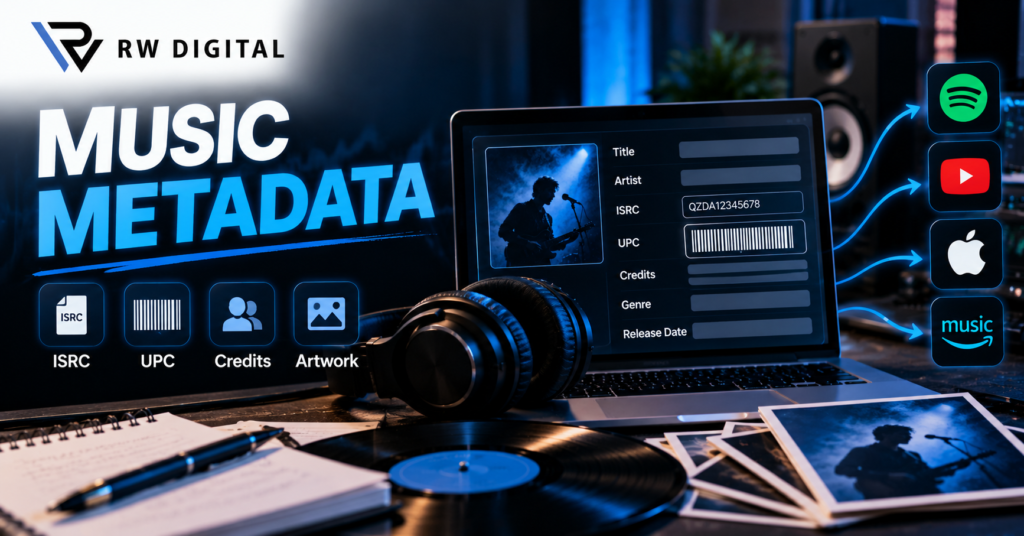
When you prepare a song for release, you probably spend most of your time perfecting the sound, choosing the right cover art, and planning how to promote it. But there is another important part of the process that artists sometimes overlook: music metadata.
Music metadata is the information that identifies a song, describes its creators, and helps digital music services organize and deliver a release correctly. Whether you are releasing your first single or managing a complete album, accurate metadata can make your music distribution process much smoother.
A small mistake in an artist name, songwriter credit, release date, or recording identifier can create unnecessary confusion. That is why understanding music metadata is an essential step for independent artists, record labels, producers, and anyone preparing a music release.
In this guide, we will explain what music metadata means, how ISRC and UPC codes work, why song credits matter, and what you should know about artwork before you distribute music to streaming platforms.
What Is Music Metadata?
Music metadata is the information attached to a musical recording and its release. It helps digital music distribution platforms identify songs, display the correct information, organize releases, and connect recordings with the appropriate artists and contributors.
Think of metadata as the identity card for your music. The audio is what listeners hear, while metadata tells platforms and listeners who created it, what it is called, and how it should be presented.
Common music metadata fields include:
- Song title and version
- Primary artist and featured artists
- Album or EP title
- Release date
- Genre and language
- Songwriter and composer names
- Producer and other contributor credits
- ISRC for an individual recording
- UPC or EAN for a release
- Copyright and phonogram information
- Cover artwork
The exact information required depends on the distributor and the platform receiving your music.
For independent artists, understanding music metadata can help prevent avoidable errors and make future releases easier to manage. It is particularly important when working with multiple music distribution platforms.
Why Is Music Metadata Important for Independent Artists?
Many new musicians assume that uploading a finished audio file is enough to release a song. In reality, a digital music release includes several pieces of information that need to match.
Imagine releasing a song under the name “Ravi Kumar” and then submitting another release as “Ravi K.” The platforms may not automatically recognize that both releases belong to the same artist. Incorrect information can contribute to artist-profile mix-ups or make releases harder to manage.
Accurate music metadata helps with:
1. Correct artist identification: Consistent artist names and identifiers help reduce confusion between musicians with similar names.
2. Better release organization: Titles, versions, album names, and release dates help platforms display the right information.
3. Accurate contributor credits: Songwriters, composers, producers, and performers can be credited appropriately when the distributor supports those fields.
4. Smoother music distribution: Complete, consistent information reduces the risk of preventable metadata corrections and delivery delays.
5. Professional presentation: Correct spelling, consistent credits, and suitable artwork create a more polished release.
Metadata alone does not guarantee more streams, playlist placements, or higher search rankings. Its value lies in helping your music be identified, presented, and managed accurately.
What Is an ISRC Code in Music?
ISRC stands for International Standard Recording Code. It is an identifier used to distinguish a particular sound recording or music video recording.
An ISRC is associated with a recording, not simply with the song title. This distinction matters because the same composition may exist in several different recordings, such as an original studio version, a live performance, or a new recording.
For example, suppose you release a studio version of a song and later record an acoustic version. These are different recordings and generally require separate ISRCs.
An ISRC typically contains 12 characters, structured into elements that identify the registrant, year of reference, and recording designation.
Why Does an ISRC Matter?
An ISRC helps identify recordings within music distribution and rights-management workflows. It can be useful for recording identification, reporting, and tracking where supported by the relevant services.
Independent artists should pay attention to ISRC information because assigning or reusing codes incorrectly can create confusion between different recordings.
How Do You Get an ISRC Code for a Song?
The process depends on your country and distribution provider. Many digital music distributors can assign ISRCs to eligible recordings as part of their delivery process. In some cases, artists or labels may obtain codes through an authorized national agency or another recognized route.
Before assigning a new code, check whether your recording already has a valid ISRC.
If you are distributing a previously released recording again, you may be able to retain its existing ISRC when the recording itself qualifies and the distributor’s rules permit it. A new recording or materially different version may need a new identifier.
Tip: Keep a record of every song title, version, ISRC, release date, and distributor used. This simple habit makes managing a growing music catalogue much easier.
What Is a UPC Code in Music Distribution?
UPC stands for Universal Product Code. In music distribution, a UPC or an applicable EAN barcode identifier is commonly used to identify a product or release, such as a single, EP, or album.
The easiest way to understand the difference is to think of an ISRC as identifying an individual recording and a UPC as identifying the release package.
For example, an album containing ten tracks may have one UPC for the album release and separate ISRCs for its individual recordings.
A single-track release can also have its own UPC as well as an ISRC for the recording.
Why Is a UPC Important?
A UPC helps distributors and digital services identify a release in their catalogues and delivery systems. It is useful when managing singles, albums, EPs, and different release packages.
You should confirm whether your distributor assigns a UPC automatically or allows you to provide an existing valid code.
Avoid creating duplicate identifiers unnecessarily. If you are re-releasing an existing product, ask your distributor whether the original UPC should be retained or whether a different release setup is required.
ISRC vs UPC: What Is the Difference?
The terms can sound confusing when you are preparing your first music release. However, they serve different purposes.
| Feature | ISRC | UPC/EAN |
| Main purpose | Identifies a recording | Identifies a release or product |
| Common use | Individual track or music video recording | Single, EP, album, or release package |
| Example | A studio recording of a song | The album containing that recording |
| Can a release contain several? | Yes, typically one per distinct recording | A release commonly has one primary release identifier |
| Assigned through | Distributor or recognized ISRC route | Distributor or appropriate product-identification route |
Consider an EP with five tracks. Each recording generally has its own ISRC, while the EP has a release-level UPC or EAN.
The key point is simple: ISRC and UPC are not interchangeable. Keeping both identifiers correctly documented makes your music release metadata easier to manage.
Music Credits: Who Should Be Listed on Your Release?
Music credits recognize the people who contributed to creating a recording. They can include songwriters, composers, lyricists, producers, featured performers, and other contributors.
Correct credits matter because music is often a collaborative process. A track might involve a vocalist, lyricist, composer, beat producer, recording engineer, and mixing or mastering engineer.
Before submitting your music, confirm the correct names and roles for everyone who should receive credit.
Common music credits include:
- Primary artist: The main artist or act releasing the recording.
- Featured artist: An additional artist appearing on the track.
- Songwriter or lyricist: The person who wrote the lyrics or contributed to songwriting.
- Composer: The person who composed the musical work.
- Producer: The person responsible for guiding or creating the recording production.
- Mixing engineer: The professional who balances the recorded elements.
- Mastering engineer: The professional who prepares the final master.
Not every distributor or platform displays every credit field, and the available roles may differ.
How Can Incorrect Music Credits Affect Your Release?
Incorrect credits can misrepresent the people involved in a recording and create problems when correcting a release later.
For example, a featured artist may be entered as part of the song title instead of being added to the appropriate artist field. Another common mistake is using inconsistent spellings for a songwriter or producer across multiple releases.
To avoid these issues, collect contributor details before uploading. Confirm names, roles, spelling, and any required permissions with the people involved.
Also, do not assume that entering a songwriter’s name automatically registers a copyright, establishes ownership, or guarantees royalty payments. Those matters depend on applicable law, agreements, registrations, and the relevant rights-management systems.
Music Artwork Requirements for Streaming Platforms
Your cover artwork is often the first visual element a listener sees when discovering your music. It is an important part of your release presentation, but it also needs to meet the technical requirements of your distributor and target platforms.
Before submitting your artwork, check the current specifications provided by your distributor.
Common artwork considerations include:
Square format: Music cover art is generally submitted as a square image.
High resolution: Use a clear, high-quality image that meets the required pixel dimensions.
Correct file format: Your distributor may specify JPEG or another supported format, along with file-size requirements.
Readable design: Avoid tiny text or details that become difficult to see at smaller sizes.
Accurate information: Artist names, titles, logos, and other artwork elements should match the release and comply with platform policies.
Rights and permissions: Use artwork, photographs, fonts, logos, and other visual elements only when you have the necessary rights or permissions.
Avoid adding misleading platform logos, unsupported promotional claims, unrelated artist names, or information that violates a distributor’s artwork rules.
Common Music Artwork Mistakes to Avoid
Artists sometimes upload blurry images, use artwork with incorrect titles, or submit images containing material they do not have permission to use.
Another mistake is assuming that artwork specifications are identical across every platform. Your distributor’s current artwork guidelines should be your main reference.
Preparing a final, approved cover before submitting your release can save time and reduce the chance of corrections.
Music Metadata Checklist for Artists
Before you distribute music, use this music release metadata checklist to review the essential information.
Track information
- Confirm the official song title and version.
- Check the primary and featured artist names.
- Select the appropriate language and genre.
- Verify the recording’s ISRC or follow your distributor’s assignment process.
- Confirm that explicit-content information is accurate.
Release information
- Confirm whether the release is a single, EP, or album.
- Check the release title and intended release date.
- Verify the UPC or EAN assigned to the release.
- Confirm the territories and platforms selected for distribution.
- Make sure the track listing and track order are correct.
Credits and rights
- Check songwriter, composer, producer, and performer credits.
- Confirm spelling and contributor roles with collaborators.
- Make sure you have the necessary rights and permissions.
- Review relevant agreements and royalty-split arrangements.
- Keep a copy of the final approved metadata.
Artwork and final review
- Check image dimensions, format, and quality.
- Verify that the artwork matches the release.
- Confirm that you have permission to use all visual elements.
- Review every field before submitting.
- Save the final release details in a secure catalogue spreadsheet.
A consistent checklist helps independent artists manage repeated releases without relying on memory every time.
How Music Distribution Platforms Use Metadata
Music distribution platforms help deliver recordings and their associated information to streaming services and digital music stores.
When you submit a release, your distributor collects the audio files, artwork, identifiers, credits, and other required information. It then delivers the release according to its processes and the requirements of the selected services.
The platforms may validate information, apply their own formatting rules, or request corrections if a submission does not meet their requirements.
That is why it is important to review the distributor’s submission guidelines rather than assuming every service follows exactly the same process.
For artists exploring music distribution India, the basic principles remain the same: use accurate information, maintain consistent artist identities, verify rights, and choose a distribution provider whose services and terms meet your needs.
When comparing music distribution platforms, consider the supported stores, pricing, royalty and payout terms, customer support, metadata-editing options, and the process for correcting or removing releases.
A distributor can help deliver your music, but you remain responsible for providing accurate information and ensuring that you have the necessary rights.
Common Music Metadata Mistakes to Avoid
Even experienced musicians can make avoidable mistakes when managing multiple releases. Here are some common problems to watch for.
1. Using different artist names: Keep the spelling and formatting of your artist name consistent across releases.
2. Confusing ISRC with UPC: Remember that the recording identifier and release identifier serve different purposes.
3. Entering incomplete credits: Collect contributor information before the upload rather than trying to reconstruct it later.
4. Reusing identifiers incorrectly: Check whether an existing recording or release identifier should be retained before assigning a new one.
5. Uploading incorrect artwork: Review the image specifications, title, artist name, and usage rights.
6. Ignoring release dates: Confirm your intended release date and allow enough time for your distributor’s review and delivery process.
7. Failing to keep records: Maintain a central spreadsheet containing track titles, versions, identifiers, credits, release dates, and distribution status.
Good metadata management is not complicated when you establish a consistent process from the beginning.
How RW Digital Can Help With Music Distribution
Preparing a professional release involves more than uploading an audio file. Artists need to organize their metadata, confirm their artwork, manage credits, and understand how their music will be delivered to digital platforms.
RW Digital provides music-related services designed to support artists with their distribution and digital promotion needs. Depending on the service selected, artists can explore support related to music distribution, music metadata management, YouTube Content ID monetization, and music promotion.
If you are preparing your first release, start by organizing your audio files, artwork, artist details, credits, and any existing ISRC or UPC information. Then review the requirements and terms of the distribution service you plan to use.
If you need help understanding the process or choosing a suitable service, contact RW Digital to discuss your requirements.
The goal is to help you approach every release with better preparation, accurate information, and a more organized workflow.
Frequently Asked Questions About Music Metadata
1. What is music metadata?
Music metadata is the information used to identify and describe a recording or release. It includes song titles, artist names, release dates, credits, identifiers, and artwork details.
2. What is the difference between ISRC and UPC?
An ISRC identifies a particular sound recording, while a UPC or EAN commonly identifies a release or product, such as a single, EP, or album.
3. Do independent artists need an ISRC code?
An ISRC is commonly used to identify a recording in digital music distribution. Depending on the distributor, a code may be assigned during the release process or obtained through a recognized route.
4. What information is needed to distribute a song?
Requirements vary by distributor, but they commonly include an audio file, song title, artist information, release date, genre, artwork, credits, rights information, and recording or release identifiers where applicable.
5. Why are music credits important?
Credits identify the people who contributed to a recording. Accurate credits help represent contributors correctly and support the relevant music-distribution and rights-management workflows.
6. What artwork is required for music distribution?
Artwork generally needs to meet the distributor’s image dimensions, file-format, quality, and content requirements. Always review the current specifications before uploading.
7. Can incorrect music metadata delay a release?
It can. Incomplete or inconsistent information may trigger corrections or additional review. Submitting accurate details and allowing enough delivery time can help reduce avoidable problems.
8. Does music metadata improve Spotify streams or Google rankings automatically?
No. Accurate metadata helps identify and present your music correctly, but it does not guarantee streams, playlist placements, or search rankings. Promotion, audience interest, content quality, and other factors also matter.
Final Thoughts
Music metadata is a fundamental part of releasing music professionally. From ISRC and UPC codes to contributor credits and cover artwork, every detail helps establish how a recording and its release are identified and presented.
For independent artists, a reliable music metadata checklist can prevent common mistakes and make future releases easier to manage. Whether you are preparing one song or a complete album, take the time to review your information before submitting it to your distributor.
If you want to distribute music with a more organized approach, explore the music distribution and metadata-related services available through RW Digital.
Prepare your metadata. Protect your creative work. Give every release a professional start.
About the Author
RW Digital
RW Digital shares practical resources for independent artists, musicians, and music creators who want to understand music distribution, music promotion, metadata management, and digital music services.
Contact RW Digital
Need help with music distribution or music metadata management? Get in touch with RW Digital to discuss your release requirements.
- Website: https://rwdigital.in/
- Email: rwdigital02@gmail.com
- Phone: +91 93067 16873
- Address: High School Road, Mandi Adampur, Hisar, Haryana – 125052
RW Digital — Supporting artists through music distribution and digital music services.