
Running a record business is way more than finding amazing artists.
A label may start with one artist and a handful of releases, but with a growing library comes a growing burden. Suddenly you are handling many artists, release schedules, streaming platforms, royalties, metadata, analytics, copyrights, and promotional plans.
This is where music distribution fits into the workflow of a modern record label.
Whether you are an established label, an indie imprint, or establishing your first catalog in India, understanding how digital distribution works will help you release music more efficiently and preserve better control over your catalog.
But what role does distribution play for a record label?
Let’s break it down.
What Is a Music Label?
What is a record label? Before we get into distribution, let’s address a simple question.
A record label is a business or firm that works with musicians to develop, release, manage, and commercialize recorded music.
Depending on its size and economic approach, a label may include:
• Artists Management
• production and recording
• Releasing music
• Promotion & Marketing
• Management of copyright
• Distribution in digital
• Collection of royalties
• Managing catalog
• Reporting and analytics
A modern record company doesn’t always require a large physical headquarters or a big crew.
With the correct digital infrastructure, a rising Indian label can handle many artists and disseminate releases to consumers around the world.
Why Do Record Labels Need Music Distribution?
It’s really easy for a label to put out one song.
Managing 50, 100, or 500 releases presents a completely different set of challenges.
A professional distribution system is the bridge between your label’s portfolio and digital music platforms.
Instead of manually dealing with each platform, a distributor can help you deliver your releases, organize metadata, track performance, and manage the information related to your collection.
Modern Indian distribution networks tend to focus on global platform coverage, royalty reporting, analytics, release workflows, and label-specific infrastructure.
For a label that is growing, such a system means less time spent on monotonous admin tasks and more time spent developing artists.
How Does Music Distribution Through Record Labels Work?
Visualize it as a simple chain of:
Label → Distributor → Digital Platforms → Listeners → Royalties & Analytics
Here’s what will happen.
1. The label is preparing to release
The label prepares the final master, artwork, metadata, and contributor details.
2. Submitted for Release
The label distributes through its system.
3. The Distributor Releases
The distributor verifies the information provided and assembles the release for distribution.
4. The Music Hits Digital Platforms
It can then be transmitted to supported streaming and digital channels for release.
5. Track Performance
Once the song starts streaming, the label has to be able to get performance and royalties data.
The last part is especially crucial.
Distribution is not merely about getting a song online.
The harder problem for a record label is all the stuff that happens after the release goes live.
What Does A Record Label Look For In A Distributor?
“Don’t just pick a distributor because they are the cheapest,” she said.
Labels want infrastructure that can scale with their growing portfolio.
Here are a few key things to look for.
1. Reach Platform
Your artists’ fans could be on Spotify, Apple Music, YouTube Music, Amazon Music, JioSaavn, and various other platforms.
The wider the network supported, the easier it was to reach different audiences.
Regularly, current Indian distribution competitors position delivery to 100+ or 150+ platforms as a key feature of the market positioning.
But don’t judge a distributor by the quantity of logos on its website.
Find out which social media sites really matter to your artists and audience.
2. Multi-Artist Management
This is one of the major contrasts between distributing music as a label and as an individual artist.
A label might handle:
• Artist A new single
• EP by Artist B
• Artist C album
• Artist D’s back catalog
When you have everything spread out among different accounts, confusion can arise quickly. Confusion can arise quickly when everything is spread out among different accounts.
A label-centric system should facilitate organizing many artists and releases from one place.
3. Catalog Management.
Your catalog is one of the most significant assets of your record label.
It has your released recordings, artist info, credits, release dates, and historical performance.
As your catalog increases, it becomes increasingly critical to keep information accurate.
An effective distribution procedure should assist your team in keeping releases organized, not treating each new song as its own independent project.
4. Reporting of Royalty
“Getting streams is part of the business.
A label has to understand:
How much did you earn?
Which release was it made in?
The artist that made it is
Which platform produced it?
To what timeframe does the revenue pertain?
Good reporting can make managing royalties a whole lot easier.
Part of the reason is that more and more label-centric distribution firms are focusing on royalty dashboards, analytics, and reporting instead of just saying, “We upload your songs.”
Music Distribution in India: What Labels Should Know
The Indian digital music sector has its unique needs.
Indian labels can deal with musicians who make music in Hindi, Punjabi, Haryanvi, Bhojpuri, Tamil, Telugu, Bengali, and many other languages.
This means a label may need both:
Global reach and relevance of the Indian platform
Current India-focused distributors market their delivery to services like Spotify, Apple Music, YouTube Music, and JioSaavn, particularly, with some also highlighting regional and label services.
So, for an Indian label, the proper distribution partner must comprehend the worldwide streaming environment as well as the reality of the Indian music business.
Does Free Music Distribution Help Record Labels in India?
Many new brands ask themselves this question:
“Can I distribute music free in India?”
The answer is both yes and no, but you should know exactly what “free” means.
Some platforms allow distribution for free but may be set up to share revenue, require paid upgrades, or have other stipulations. Currently in India, services are advertising several methods, ranging from absolutely free distribution to commission-based or paid plans.
Don’t choose a distributor just because its website says “free.”
Before you choose a plan, make sure you check the following:
• Revenue share
• Ownership Terms
• Number of artists supported
• Number of permitted releases
• Catalog availability
• Reporting of royalties
- Analytic
• Assist
• Release schedule
• Additional services for monetization
For a serious label, the least expensive choice isn’t generally the best value option.
The infrastructure itself is valuable if better reporting saves your team hours each month.
Distribution by Record Companies and Distribution by Individual Artists
The basic release method may be the same, but the requirements are different.
Music Performer (Solo)
An artist may need to:
• Upload Tools
• Platform Release
• Royalty tracking
Artist analytics
• Basic support
Label
A label may have to:
• Multi-artist management
• Catalog structure
• Different releases
• Revenue reporting.
• Performance analytics
• Releases planning
• Dedicated support
• Infrastructure is scalable.
This is why you need to treat record label distribution differently than just uploading a song.
A label is not running one release.
It’s running a roster of artists and a catalog.
How to Build an Effective Label Release Workflow
A straightforward workflow will prevent many typical blunders.
Step 1: Plan the Release
Set release date, artist, title, and distribution platform.
Step 2: Preparing the Master
Make sure the final audio is ready to go.
Step 3: Prepare the Artwork
Use appropriately licensed and acceptable artwork for the distribution.
Step 4: Metadata Validation
Verify:
• Name of artist
• Title of the Track
• Spotlight on artists
• Songwriters
• Products
• Information on copyright
• Date de sortie
Step 5: Submit the Release Form
Upload throughout your distribution system.
Step 6: Check Before Shipment
Check carefully all fields before final submission.
Step 7: Track the Release
Once it’s live, monitor streams, audience activity, and income.
Step 8: Update the Catalog
And don’t overlook older releases.
A successful label needs to handle both new releases and its catalog.
Common Mistakes to Avoid When Running a Record Label
Even seasoned teams can make needless blunders.
Artist Names Are Wrong❌
A minor spelling change can cause misunderstanding with artist profiles.
❌ Incorrect Metadata
And wrong credits can be a problem for artists and rights management.
❌ Bad Release Planning
Last-minute release submissions leave little time to resolve issues.
❌Ignoring Old Catalog
Sometimes labels just look at new releases and not how older music is doing.
❌ Don’t Only Choose By Price
If a cheap plan doesn’t give your label the tools it needs, then it’s not worth a damn.
❌ No Centralized Reporting
When your revenue and data are distributed across several systems, managing artists becomes a headache.
Why Do Record Labels Choose RW Digital?
RW Digital’s mission is not just to get another song online.
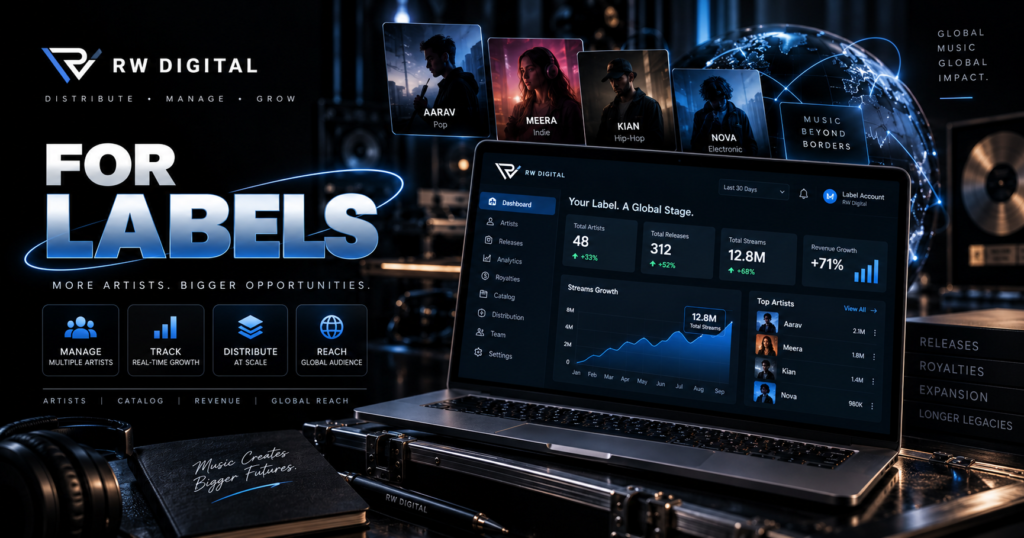
The For Labels service is designed around the needs of labels managing multiple artists and a growing music catalog.
RW Digital provides label-focused tools, including:
• Multi-artist dashboard
- Catalog management.
• Analytics & Revenue Reporting
• Support for dedicated label
• Infrastructure for music distribution
• Release management
• Insight on performance
These capabilities are designed for labels that need to manage artists, revenues, and performance at scale.
And it matters because a label’s needs alter as its catalog grows.
If you are managing one artist, you might only need a simple upload system.
If you manage more than one artist, you need a system that allows you to organize, monitor, and get the bigger picture of the complete catalog.
That’s where RW Digital’s label-centric approach comes into play.
Why Indian Record Labels Are Going Digital
The conventional music business was highly reliant on physical formats, radio, and other offline media.
A release, with no actual CD ever made, can be heard by people in several countries today.
This opens up potential for Indian labels to take regional music to the world.
Haryanvi music can have listeners beyond Haryana.
A Punjabi film can reach people anywhere in the world.
An independent Hindi label can build an international catalog.
Digital platforms have been able to eliminate most of the geographical restrictions that used to hinder music discovery.
But getting to such audiences requires a solid distribution workflow.
The Future of Distribution for Record Labels
The future of the music industry is not only about more songs on streaming platforms.
It is about data, about ownership, about catalog intelligence, about managing it efficiently.
Labels are increasingly needing to know:
Which artist is getting bigger?
What release is performing?
How much money does the platform make?
Which catalog deserves more attention?
Where do the listeners come from?
The label that knows its data can make better decisions.
And the label that matches good artists with coordinated distribution can establish a much better repertoire in the long run.
Commonly Asked Questions
What is music distribution for labels?
It’s the act of sending a label’s recorded music and associated information to compatible digital music platforms and assisting in managing releases, reporting, and catalog-related procedures.
What does record label distribution mean?
Record label distribution is the specialized method of getting music owned or managed by a record label onto digital music services and controlling the release and reporting process for that music.
Can a record label employ free music distribution in India?
Yes, there are services that provide free / ₹0 upfront plans in India. But, before choosing one, labels should carefully examine revenue splits, ownership terms, artist limits, reporting features, and other factors.
What is the difference between label distribution and artist distribution?
Artist distribution is typically focused on one artist and that artist’s releases. Label distribution has to handle various artists, broader libraries, income reporting, and scalable management.
What to Look for in a Record Label Distributor?
Don’t just count the number of platforms advertised. Consider platform reach, catalog management, multi-artist tools, royalty reporting, analytics, support, release workflows, and pricing.
Is music distribution in India available to independent record labels?
Yes. There are many India-focused services today that provide distribution and label-oriented solutions for Indian artists and record labels.
So why should a record company worry about catalog management?
The more artists and releases you have, the more crucial it becomes to keep metadata, performance data, and income structured. This can be a centralized system that can simplify this process. easier with a centralized system.
Can RW Digital aid record labels with various artists?
Yes. RW Digital’s For Labels service is centered on multi-artist administration, catalog workflows, revenue and analytics reporting, and specialized label support.
Expand Your Label. Control Your Catalog Expand your audience.
It’s not the next release; it’s the next asset of a record label.
It’s the catalog it accumulates over time.
The correct distribution infrastructure may help that catalog find digital audiences while offering your team improved visibility into artists, releases, revenue, and performance.
Are you creating a record label in India? Or managing several artists? RW Digital can help you construct a more structured digital release process.
Want to upgrade your label catalog?
Learn about RW Digital’s For Labels solution and create a smarter distribution workflow for your artists and releases.
Find RW Digital Services.
📍 Follow on RW Digital
RW Digital – RFID
Near High School Road, Mini Bank Street, Mandi Adampur
Phone: +91 9306716873
Email: rwdigital02@gmail.com
Website: https://rwdigital.in/