
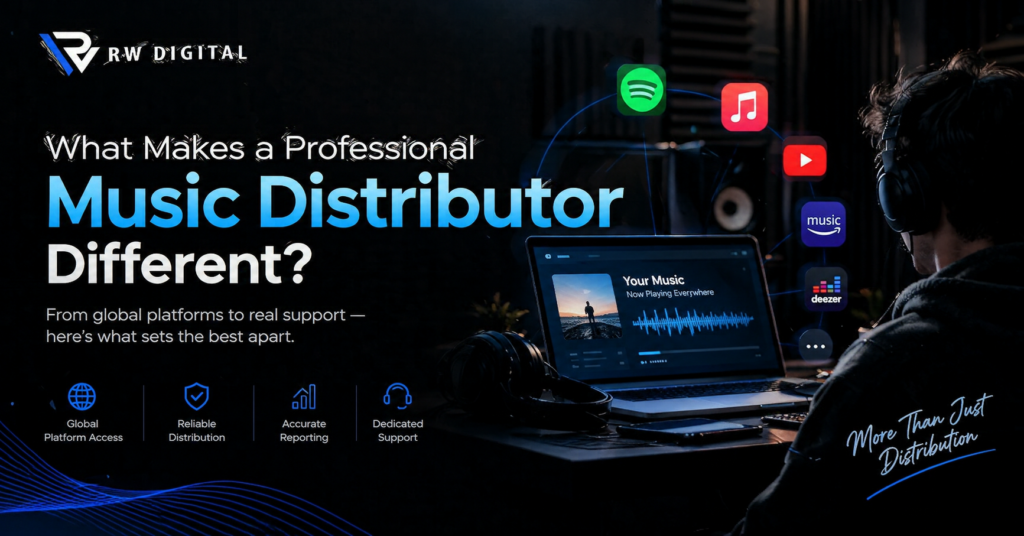
Every artist dreams of seeing their music on Spotify, Apple Music, YouTube Music and other streaming platforms. But releasing a song involves much more than uploading an audio file and waiting for listeners to discover it. Artists also need accurate metadata, suitable artwork, a well-planned music release, reliable reporting and support when something goes wrong.
This is where choosing the right Music Distributor becomes important.
A professional music distributor helps artists deliver their music to digital platforms through an organized distribution process. Depending on the services offered, a distributor may also support release scheduling, metadata management, royalty reporting, catalog management and other parts of an artist’s digital music journey.
However, not every distributor offers the same features, level of support or flexibility. Some services focus mainly on delivering tracks to streaming platforms, while others offer additional tools to help independent artists and record labels manage their releases.
In this guide, we will explore what makes a professional music distributor different, what artists should check before choosing one, and how the right digital music distribution partner can help build a more organized music career.
1. What Is a Music Distributor?
A music distributor is a service provider that helps artists, record labels and music rights holders deliver their recordings to digital music platforms.
These platforms may include Spotify, Apple Music, Amazon Music, YouTube Music and other supported streaming services.
Without a suitable distribution arrangement, an independent artist may find it difficult to deliver music to multiple platforms independently. Digital music distribution simplifies this process by providing a central workflow for submitting releases and managing their delivery.
A music distributor may help with:
- Delivering audio recordings to supported streaming platforms.
- Submitting album artwork and release information.
- Managing artist names, track titles and other metadata.
- Scheduling a music release for a selected date.
- Providing royalty statements and available performance reports.
- Updating release information or processing eligible takedown requests.
The exact services depend on the distributor and the selected plan. Therefore, artists should always review the provider’s terms, platform coverage, fees and support options before signing up.
2. What Makes a Professional Music Distributor Different?
A professional music distributor is not defined only by the number of platforms it supports. The quality of its processes, transparency and ability to help artists manage their releases are equally important.
Reliable Digital Music Distribution
A professional distribution service should have a clear submission process and explain how music is delivered to supported platforms.
Artists should understand the required audio formats, artwork specifications, metadata fields and submission deadlines before starting a release.
Reliable digital music distribution also means communicating the process clearly instead of promising that every release will be accepted or published instantly. Streaming platforms may have their own review procedures, policies and delivery timelines.
Accurate Metadata Management
Metadata is the information attached to a music release. It can include the track title, artist name, featured artists, songwriter credits, release date, language, genre and other relevant details.
Incorrect metadata can create problems such as misspelled artist names, incorrect credits or confusion between artists with similar names.
A professional music distributor should provide clear metadata requirements and a process for correcting errors where supported.
Before submitting a release, artists should carefully check every field. Correct information helps maintain consistency across their music catalog and reduces avoidable release problems.
Proper Music Release Scheduling
Timing matters when planning a music release. Artists may want to coordinate their launch with a music video, promotional campaign, festival, special occasion or collaboration.
A suitable distributor should explain how far in advance a release needs to be submitted and whether the selected platform supports the requested release date.
Artists should avoid leaving submissions until the last minute. Advance planning provides more time to review metadata, prepare artwork, organize promotional content and address potential delivery issues.
Remember that a scheduled release date is not always a guarantee of publication at an exact time across every platform.
Transparent Royalty Reporting
Many artists want to understand how their music performs and what revenue their recordings generate.
A professional music distributor should clearly explain how royalty reporting works, what deductions or fees may apply, when statements become available and how payments are processed.
Artists should check:
- Whether the service charges a subscription or distribution fee.
- Whether a revenue share applies.
- How royalty statements can be accessed.
- What payment thresholds or processing conditions apply.
- How reporting delays and adjustments are handled.
Streaming revenue can vary depending on many factors, including platform, listener location, subscription type, rights ownership and applicable agreements. No distributor can responsibly guarantee a fixed amount of money for every stream.
Transparent reporting helps artists make better financial decisions without relying on unrealistic earning promises.
3. Independent Music Distribution: Why the Right Support Matters
Independent artists often manage several responsibilities at once. They may record songs, arrange collaborations, design artwork, create social media content and plan promotional campaigns without the support of a large record label.
Independent music distribution gives these artists a way to deliver their recordings to supported digital platforms while maintaining control according to their distribution agreement.
However, independence also means artists need to pay attention to details that a dedicated team might otherwise handle.
For example, an independent singer preparing a new single may need to coordinate:
- Final audio mastering and quality checks.
- Artwork and release metadata.
- Distribution submission and scheduling.
- Social media teasers and promotional content.
- Post-release performance tracking.
A good distributor can make the distribution side of this process more organized. Additional services may help with other tasks, but artists should check which features are actually included rather than assuming every distributor offers the same support.
For independent artists, the best option is not necessarily the cheapest service. It is the one that fits their release frequency, budget, rights requirements and long-term plans.
4. How to Choose Between Music Distribution Platforms
There are many music distribution platforms available, and comparing them carefully can help artists avoid unexpected costs or limitations.
Instead of choosing a distributor only because it advertises a large number of streaming platforms, evaluate the complete service.
Compare Pricing and Revenue Policies
Some distributors charge per release, some offer subscriptions, and others use different pricing or revenue-sharing arrangements.
Read the current pricing details carefully. Check renewal charges, additional service fees, payment conditions and what happens if you stop using the service.
Check Platform Coverage
Confirm that the distributor supports the digital stores and streaming platforms relevant to your audience.
Do not assume that every service delivers to every platform. Coverage can vary by provider, territory, plan and release type.
Evaluate Customer Support
Consider what happens if your release is delayed, your artist profile is incorrect or you need to update release information.
Look for a clearly documented support process, realistic response expectations and useful guidance for resolving common problems.
Understand Rights and Takedown Policies
Before distributing a recording, confirm that you have the necessary rights or permissions for the audio, samples, compositions and other material included in the release.
Review the agreement to understand ownership, licensing permissions, exclusivity requirements and takedown procedures.
A distributor generally does not automatically own your music simply because it distributes it. However, the precise rights granted depend on the agreement you accept.
Review Reporting and Catalog Management
If you release music regularly, organized catalog management becomes increasingly valuable.
Check whether you can access release histories, royalty statements, metadata updates and other records without unnecessary manual work.
These details can make a significant difference as your catalog grows.
5. The Role of Music Distribution in a Successful Music Release
Distribution makes music available through supported platforms, but availability alone does not guarantee listeners, streams or commercial success.
A successful music release usually requires several activities working together.
Before release: Finalize the recording, prepare artwork, verify metadata and submit the track with enough time for processing.
During launch: Publish relevant promotional content, share official streaming links and communicate with your existing audience.
After release: Review available analytics, identify which content attracts listeners and plan future campaigns based on actual results.
Artists can also explore suitable playlist pitching opportunities, collaborations, music video promotion and short-form content, depending on their budget and goals.
A professional music distributor should make the distribution process clear, while artists and their teams develop a broader strategy for connecting with listeners.
For additional promotion, artists may choose separate services for YouTube promotion, Instagram Reels promotion or music marketing. These services should be evaluated independently from distribution, with realistic expectations and transparent methods.
6. Common Mistakes Artists Should Avoid
Even a good distributor cannot eliminate every problem caused by incorrect submissions or unrealistic expectations.
Here are some common mistakes to avoid:
Uploading without checking metadata: Verify artist names, credits, track titles and release dates before submitting your music.
Submitting too close to launch day: Allow sufficient time for delivery, platform review and corrections.
Ignoring the distribution agreement: Understand fees, rights, payment policies and takedown conditions before accepting the terms.
Expecting automatic streams: Distribution makes music available; it does not automatically generate an audience.
Ignoring royalty statements: Review reports regularly and keep records of your releases and earnings.
Choosing only on price: Consider support, workflow, transparency and long-term suitability alongside the cost.
Using artwork or audio without permission: Confirm that you have the required rights for all material included in the release.
Avoiding these mistakes can make the release process more predictable and help artists manage their music careers with greater confidence.
7. Why Consider RW Digital for Music Distribution?
At RW Digital, we understand that independent artists and music labels need a clear, organized approach to getting their music ready for digital distribution.
Our services are designed to support different parts of an artist’s digital music journey, including music distribution and related promotional services.
Depending on your requirements and the services available for your release, RW Digital can help you explore solutions connected with:
- Music Distribution: Support for delivering music to supported digital platforms.
- Music Release Planning: A more organized approach to preparing releases and their information.
- Music Metadata Management: Attention to accurate release details and artist credits.
- YouTube Promotion: Promotional options for artists looking to increase the visibility of their content.
- Instagram Reels Promotion: Promotional support for short-form music content.
- Music Marketing: Strategies and services designed to help artists present their music to relevant audiences.
Before choosing any service, discuss your release requirements, expected timeline, pricing and applicable terms with the team. Availability and eligibility may vary depending on the service and the release.
Our aim is to help artists understand their options and make more informed decisions about distributing and promoting their music.
If you are an independent artist, producer or record-label owner planning your next release, RW Digital can be a starting point for discussing your music distribution requirements.
8. Frequently Asked Questions
What does a music distributor do?
A music distributor helps artists and rights holders deliver recordings to supported digital music platforms. Depending on the provider, services may also include metadata management, release scheduling and royalty reporting.
How do I distribute music independently?
Prepare your final audio, artwork and accurate metadata. Choose a suitable distributor, review its terms, submit your release and follow the provider’s delivery requirements. Allow enough time for platform processing before the planned release date.
Are music distribution platforms free?
Some offer free entry-level plans, while others charge per release, subscriptions or additional fees. Some may also apply revenue-sharing arrangements. Always check the current terms before choosing a service.
Does a music distributor promote my song?
Not necessarily. Distribution and promotion are different activities. Distribution delivers music to supported platforms, while promotion focuses on helping people discover it. Some companies offer both as separate services.
Can I change my music distributor later?
In many cases, artists can migrate their catalogs, but the process depends on the original and new distributors. Check release identifiers, metadata consistency, rights and takedown procedures before making the change. Do not assume that every stream, playlist placement or release detail will transfer automatically.
How do I choose the best music distributor?
Compare pricing, supported platforms, rights policies, reporting, customer support, release management and catalog portability. The best choice depends on your specific needs rather than a single universal ranking.
Conclusion
Choosing a professional music distributor is an important step in building an organized music career. The right provider should offer clear processes, transparent terms and reliable support for the distribution tasks it promises to perform.
For independent artists, the goal is not simply to upload a song. It is to release music with accurate information, understand how the distribution agreement works and build a repeatable process for future releases.
Before choosing a distributor, compare your options carefully, read the terms and identify which features matter most to your music career.
If you are planning your next music release, explore the services offered by RW Digital and discuss your requirements with the team.
Contact RW Digital
RW Digital — Music Distribution & Digital Music Services
Address: High School Road, Mandi Adampur, Hisar, Haryana – 125052, India
Email: rwdigital02@gmail.com
Phone: +91 93067 16873
Website: https://rwdigital.in/